

ORLANDO, Fla. (Oct. 21, 2026) — Found alone on a remote northern Alaska beach and rehabilitated by Alaska SeaLife Center, an orphaned Pacific walrus calf now has a new home at SeaWorld Orlando, globally recognized for its marine animal expertise and one of only four U.S. institutions currently capable of housing walruses.
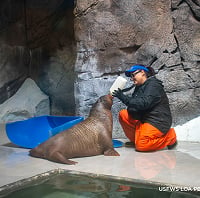
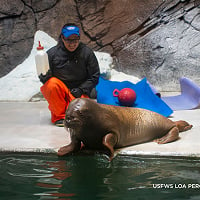
Weighing approximately 220 pounds, the five-month-old male calf, named Annautaq, is receiving around-the-clock attention from SeaWorld’s dedicated animal care and veterinary team as he settles in and prepares to join the park’s herd of walruses, including Uki, Kaboodle and Garfield. Uki is a two-year old rescued Pacific walrus that shares a similar rescue story. She has called SeaWorld Orlando home since completing rehabilitation at the Alaska SeaLife Center.
His arrival follows a rescue led by local residents and wildlife experts, specialized rehabilitation at the Alaska SeaLife Center and a collaborative effort to give him a future he could not have in the wild.
A Remarkable Rescue
Annautaq’s rescue is quite remarkable. Violet Anniskett, a wildlife research intern and local community member, and U.S. Geological Survey scientist Tony Fischbach discovered the calf on a remote beach in Northern Alaska after a walrus herd departed during heavy surf. They found the orphaned calf hiding between the older remains of two adult walruses, already being targeted by scavenging birds and unlikely to survive without intervention. They cared for him over several days before he could be flown to the Alaska SeaLife Center in Seward, with help from the local community and federal wildlife officials. The community supported Annautaq’s rehabilitation, knowing he would remain in human care and could help people better understand Pacific walruses. Anniskett named him Annautaq (pronounced “ah now-tuq”), meaning “axe” in Iñupiaq, in honor of her father’s Iñupiaq name.
SeaWorld sent animal care and veterinary staff experienced in caring for walruses to Alaska to help provide intensive care alongside the Alaska SeaLife Center team and prepare Annautaq for his 4,000 mile journey to Florida. His story is part of SeaWorld’s long-standing rescue mission, which has helped more than 43,000 animals in need.
Although Annautaq responded well to rehabilitation, the U.S. Fish and Wildlife Service determined he could not be released into the wild. Pacific walruses rely solely on their mothers’ milk for nutrition throughout their first year of life and depend on their mother for protection and the development of essential survival and social behaviors. Experts from across the walrus care community worked together to evaluate Annautaq’s long-term needs and determine which home would be best for his future. His placement at SeaWorld Orlando was guided by his long-term care and social needs, including the opportunity to grow up alongside other walruses.
“Annautaq’s story shows why having specialized marine mammal rehabilitation capacity in Alaska is so important,” said Jane Belovarac, wildlife response curator at the Alaska SeaLife Center. “When an orphaned walrus calf is found in a remote part of the state, a successful response depends on being able to move quickly from rescue to intensive, species specific rehabilitative, husbandry, and veterinary care. Our team was able to stabilize Annautaq, support his medical and social needs around the clock and prepare him for the next stage of his care. Getting Annautaq to this point took an incredible network of people, and we’re proud the ASLC could provide the specialized care that helped carry him from rescue in Alaska to his next chapter.”
Around-the-Clock Care
At SeaWorld Orlando, Annautaq is receiving up to six bottle feedings a day, veterinary care and 24-hour support during a planned 30-day quarantine to help protect the health of the resident animals. He receives a specialized high-fat milk formula originally developed by SeaWorld’s veterinary and animal care teams to mimic the rich fat content of natural walrus milk.
“At this young age, Annautaq needs more than nutrition and veterinary care. He also needs close contact and companionship, which our expert team is providing around the clock,” said Jim Kinsler, curator at SeaWorld Orlando. “As he settles in, we’ll make introductions to Garfield, Kaboodle and Uki at his pace. Kaboodle’s experience caring for rescued calves and the opportunity to connect with two-year old Uki, herself a rescued walrus, make this herd a promising setting for him to learn, build relationships and grow.”
Why the Herd Matters
While he is getting the best care possible, there are some things even the most dedicated human caregivers cannot provide — the opportunity to live with and learn from with other walruses. For an orphaned calf, the best long-term outcome is being part of a herd, which SeaWorld Orlando can provide.
The herd Annautaq will join includes:
● Uki, 2: Like Annautaq, Uki was rescued in Alaska and rehabilitated at the Alaska SeaLife Center before arriving at SeaWorld Orlando. She is thriving within the herd, has formed a close bond with Kaboodle and enjoys snow, ice and enrichment activities.
● Kaboodle, 23: An experienced mother and proven surrogate to rescued calves, including Uki. Her nurturing experience will play an important role as Annautaq is gradually introduced.
● Garfield, 44: Rescued as an orphaned male calf in Alaska and hand-raised at SeaWorld Orlando, he is a living example of what a rescued walrus can become.
As he acclimates, Annautaq will join Uki in playing an essential role as an ambassador for their species, educating the public on the challenges Pacific walruses face in the wild. His story, like those of many other animals rescued by SeaWorld Orlando, emphasizes the park’s ongoing mission to inspire action toward the protection and preservation of marine life.
The timing of herd introductions and public viewing will be guided by his animal care team. For now, guests can learn about walruses’ unique features, social bonds and discover how SeaWorld Orlando supports their care by visiting the park’s resident herd in the Expedition Odyssey animal habitat.
Follow SeaWorld (@SeaWorld) and SeaWorld Orlando (@SeaWorldOrlando) on Instagram for updates on Annautaq and visit the Alaska SeaLife Center’s Instagram (@AlaskaSeaLifeCenter) and Facebook pages for photos and videos of his rescue and early care.
About SeaWorld
SeaWorld is a leading marine life theme park and accredited zoo and aquarium that provides experiences that matter while educating and inspiring guests of all ages to care about marine life. Welcoming millions of guests every year, the parks offer fun and enriching experiences from up-close animal encounters and year-round educational programs to award-winning marine life-themed rides and attractions, special events, and exciting entertainment. For more than 60 years SeaWorld has advanced the conservation of marine life in and outside its parks through science, education, and exceptional animal care that is Humane Certified by American Humane and accredited by the Alliance of Marine Mammal Parks and Aquariums and the Association of Zoos and Aquariums. SeaWorld is one of the largest marine animal rescue organizations in the world, helping more than 43,000 animals to date. The SeaWorld Conservation Fund, a non-profit foundation established in 2003, has provided more than $20 million to nearly 1,400 organizations to advance critical research on every continent. A portion of park proceeds goes toward supporting these longstanding conservation commitments. SeaWorld parks are in Orlando, San Antonio, San Diego, and Abu Dhabi, United Arab Emirates (UAE). SeaWorld is part of the United Parks & Resorts Inc. (NYSE:PRKS) portfolio of theme park brands. For more information, visit us at SeaWorld.com.
About ASLC
Opened in 1998, the Alaska SeaLife Center operates as a 501(c)(3) non-profit research institution and public aquarium in Seward, Alaska. The Center generates and shares scientific knowledge to promote understanding and stewardship of Alaska’s marine ecosystems. The ASLC is an accredited member of the Association of Zoos and Aquariums. To learn more, visit www.alaskasealife.org.